
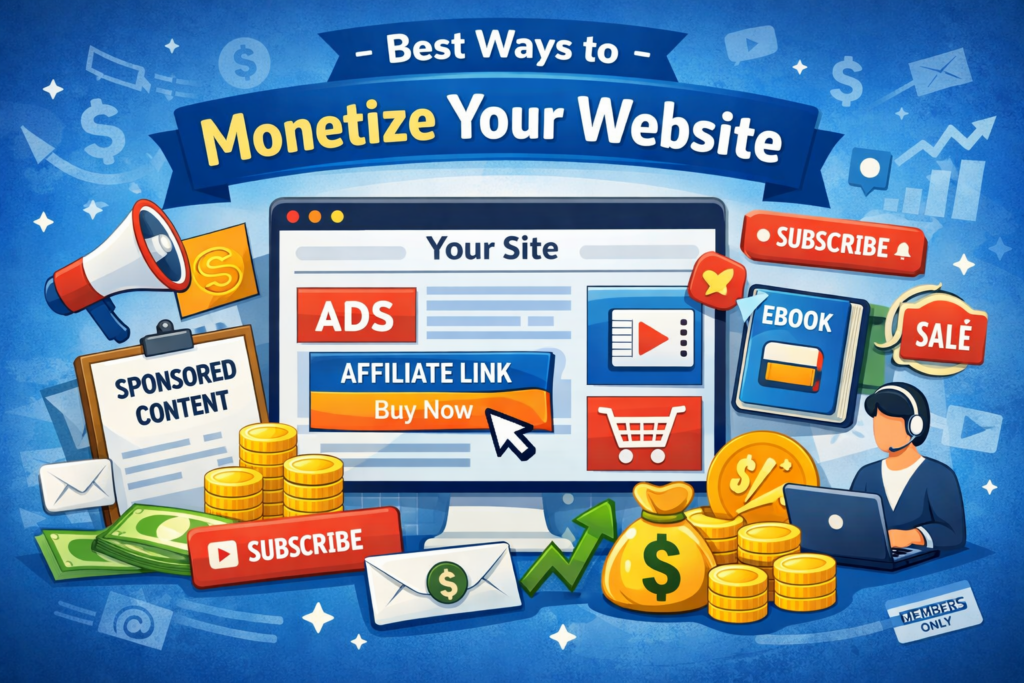
Understanding Website Monetization
When I first thought about monetizing a website, it felt awkward. Almost like crossing some invisible line. Until then, the site was just content. Writing, publishing, tweaking things, watching a few visitors show up. Monetization sounded like turning that into something transactional, and I wasn’t sure when or how that was supposed to happen.
What I noticed over time is that monetization isn’t a switch you flip. It’s more like something that naturally starts making sense once a site has a rhythm. Once people start coming not by accident, but on purpose. Once you realize the site is doing something useful for someone out there.
That’s when the idea of monetization stops feeling greedy and starts feeling practical.
What Website Monetization Really Means
For a long time, I thought monetization meant ads everywhere. Popups, banners, distractions. That idea alone made me delay it more than I probably needed to.
But what monetization really turned out to be, at least in my experience, was much quieter. It was simply finding a way for the website to earn in proportion to the value it was already giving. Nothing more dramatic than that.
Sometimes it’s recommending a tool you already use. Sometimes it’s showing an ad that fits the content instead of fighting it. Sometimes it’s offering something of your own because readers keep asking the same questions again and again.
What usually breaks things is forcing money into places where trust hasn’t formed yet. People can sense that immediately. When monetization matches intent, it blends in. When it doesn’t, it feels wrong, even if it technically works.
When You Should Start Monetizing a Website
This is where people usually get stuck, and honestly, there’s no exact moment marked on a calendar.
I’ve seen sites monetize too early and lose momentum. I’ve also seen sites wait forever, thinking they need massive traffic before doing anything, and end up missing simple opportunities.
What made the most sense to me was this. The right time to start monetizing is when you can clearly answer why someone is on your site. Not just what you write about, but what problem they’re trying to solve when they land there.
You don’t need thousands of visitors. You need clarity. A small audience that trusts you is far more ready for monetization than a large one that just scrolls and leaves. Once people start spending time, clicking related posts, or coming back on their own, monetization feels less like an interruption and more like a continuation.
That’s usually the moment when it stops being uncomfortable and starts being logical.
Display Advertising (Most Common Starting Point)
Display ads are usually the first thing people think about when they hear “website monetization.” That was true for me too. I remember setting them up early on, partly out of curiosity and partly because it felt like the obvious next step. Put ads on the site, traffic comes in, money follows. Simple.
What I didn’t realize at first is that display ads don’t change much on day one. You don’t suddenly start earning real money. Instead, they quietly sit there, collecting data, showing patterns. Over time, you start to see how traffic, page views, and content type actually affect earnings. That slow feedback loop is what makes display ads such a common starting point. They don’t demand much, and they teach you a lot.
Google AdSense and Similar Ad Networks
AdSense was the first network I tried, mostly because it was everywhere and easy to get started with. The setup felt straightforward, but approval took patience. That alone taught me something about content quality and site readiness.
Once ads were live, what surprised me was how little control you actually need. Ads adapt on their own, change formats, and match content automatically. Other networks work in a similar way, just with different rules and thresholds.
What I noticed over time is that the network itself matters less than the kind of visitors your site gets. Clean traffic with clear intent almost always performs better than random visits, no matter which network you use.
Pros and Cons of Display Ads
This is where reality sets in.
On the positive side, display ads are passive. You don’t have to create new products, handle support, or manage payments. Once they’re placed, they just run in the background.
The downside is that earnings can feel slow, especially at the beginning. Ads also take up space, and if they’re placed carelessly, they can hurt the reading experience. I’ve learned the hard way that too many ads can make a site feel cheap, even if the content is solid.
The balance between earning and user experience is where most mistakes happen.
When Display Ads Make Sense
Display ads make the most sense when your site already has steady traffic and content that people read for information rather than quick answers. Blogs, guides, and evergreen content tend to work well here.
They also make sense when you want a low-effort monetization method that doesn’t interfere too much with your workflow. If you’re still learning your audience and refining your content, ads give you room to experiment without locking you into one strategy.
In my experience, display ads work best as a foundation, not the final goal. They’re a starting layer you can build on once you understand your site better.
Affiliate Marketing
When I first tried affiliate marketing, it felt awkward. Recommending something for money felt different from just writing content. I worried it would come across as pushy or fake, especially if people could tell I was earning from it.
What changed over time was realizing that affiliate marketing isn’t about convincing people. It’s about being useful at the exact moment someone is already considering a choice. When done right, it doesn’t interrupt the content. It supports it.
How Affiliate Marketing Works
At a basic level, affiliate marketing shows up when a reader clicks a link and later buys something. But in practice, it’s less mechanical than that.
What I noticed is that people don’t click links randomly. They click when they trust the context. When a recommendation answers a question they already have, it feels natural. When it doesn’t, it gets ignored.
Over time, you start seeing patterns. Some pages quietly outperform others. Not because they sell harder, but because they help more.
Choosing the Right Affiliate Programs
This is where most early mistakes happen.
At first, it’s tempting to sign up for everything. Big commissions, popular brands, endless options. I’ve done that. It usually leads to clutter and weak results.
What worked better was slowing down and choosing programs that matched what I already talked about. Tools I had used. Services I understood. Products that solved problems my readers actually faced.
Once that alignment was there, clicks felt more intentional, and conversions followed naturally.
Placing Affiliate Links Naturally
This part took trial and error.
Early on, I placed links everywhere. Paragraphs, headings, footers. It looked busy, and it felt wrong. Over time, I learned that placement matters more than quantity.
Affiliate links work best when they appear at the moment a reader is deciding what to do next. After an explanation. After a comparison. After a real observation. That’s when a link feels like help instead of a push.
When links blend into the flow of the content, people don’t mind them. Sometimes they even appreciate them.
Common Affiliate Mistakes to Avoid
The biggest mistake I see, and one I’ve made myself, is chasing commissions instead of relevance. High-paying offers are tempting, but they rarely perform if they don’t match the audience.
Another mistake is overdoing it. Too many links dilute trust. Readers might not say anything, but they notice.
The last mistake is forgetting the reader’s point of view. If a recommendation doesn’t make sense without the link, it probably doesn’t belong there. Trust builds slowly, and affiliate income follows that pace.
Sponsored Content and Brand Deals
When sponsored content first came up for me, it didn’t feel like a win right away. It felt confusing. Someone offering money sounds good on paper, but in your head you’re thinking, wait… what exactly are they expecting from me? And what happens to the site if I say yes?
That hesitation is normal. Sponsored content sits right at the intersection of money and trust, and once you mess that up, it’s very hard to fix. What I learned over time is that brand deals aren’t automatically good or bad. They’re neutral. Everything depends on how they fit into what you’re already doing.
What Sponsored Posts Are
On the surface, sponsored posts are simple. A brand pays, you write something, they get exposure. That’s the clean version.
In reality, it’s messier. Some brands want a mention. Some want a full post. Some want control over wording. This is where people usually feel uncomfortable but don’t say it out loud.
What worked for me was treating sponsored posts like normal content first. If the topic didn’t make sense for the site without money involved, it usually wasn’t worth doing. Readers can feel when something exists only because it was paid for.
How Brands Choose Websites
This surprised me more than anything else.
Brands don’t just chase traffic numbers. They look at how a site feels. Is it consistent? Does it have a clear focus? Do people seem to trust what’s written there?
I’ve seen smaller sites get better deals than bigger ones simply because the audience was more focused. Brands want to appear where their product doesn’t feel out of place. When your content already lines up with what they offer, the conversation becomes much easier.
Setting the Right Pricing
Pricing was uncomfortable at first. I didn’t know what to charge, and honestly, I was afraid of asking for too much. At the same time, asking for too little felt wrong too.
What helped was realizing that pricing isn’t just about page views. It’s about effort, placement, and how long that content stays on your site. A sponsored post that lives there permanently has value beyond the first week.
Over time, pricing stops being guesswork. It starts reflecting how confident you are in what your site offers.
Maintaining Trust While Using Sponsored Content
This is the part that matters most.
Readers don’t leave because a post is sponsored. They leave when something feels dishonest. Hiding sponsorships or pretending you love something you clearly don’t is where things break.
In my experience, saying no to a bad fit is more valuable than saying yes to quick money. A site can recover from slow growth. It doesn’t recover easily from lost trust.
Sponsored content works best when it feels like a natural extension of the site, not a sudden change in personality.
Selling Your Own Digital Products
For a long time, this felt like something I wasn’t “ready” for. Selling your own product sounds serious. Like you need permission or a certain level before you’re allowed to do it.
What changed my mind wasn’t confidence. It was repetition. People kept asking the same things. Over and over. At some point, answering individually started feeling inefficient, not generous. That’s when the idea clicked. If the same confusion keeps coming back, maybe it deserves a permanent home.
Selling a digital product didn’t start as a business move. It started as a way to stop repeating myself.
Ebooks, Guides, and PDFs
This is where most people think too big too fast. I did too.
I imagined a full book, dozens of pages, everything perfectly covered. That idea never got finished. What worked instead was narrowing it down. One problem. One outcome. Nothing extra.
Most good PDFs aren’t new information. They’re familiar ideas arranged clearly. When I looked at my old content, I realized the material was already there. The value wasn’t in writing more. It was in removing noise.
Short, focused guides feel respectful of the reader’s time. And honestly, they’re easier to finish, which matters more than people admit.
Online Courses and Tutorials
Courses sounded exhausting at first. Cameras, editing, structure. It felt like too much.
Then I noticed something. Every course I actually liked felt more like someone walking me through their thinking than someone teaching a lesson. That changed how I looked at it.
A tutorial doesn’t need to be perfect. It needs to be clear. Pauses, corrections, small mistakes — those don’t ruin it. They make it feel real. People aren’t buying polish. They’re buying clarity they can follow.
Once I stopped aiming for “professional” and aimed for “understandable,” the whole thing became less scary.
Tools Needed to Sell Digital Products
This is where people usually get stuck, and I’ve been there.
Too many tools. Too many options. Too much setup before anything is even ready to sell.
What I learned the hard way is that tools don’t matter as much as timing. You need a place to host the file, a way to accept payment, and a way to deliver it. That’s enough to start. Everything else can come later.
A simple setup with a useful product beats a complicated setup with nothing finished. Every time.
Offering Services Through Your Website
This part crept up on me without any planning. I wasn’t trying to sell services at first. I was just writing, fixing things, explaining stuff the way I understood it. Over time, people started reaching out. Not asking for products. Asking for help. That’s when it hit me that the website was already doing half the work.
Offering services through a site doesn’t start with a services page. It starts when someone reads your content and thinks, this person probably understands my problem. The site becomes a quiet introduction before any conversation even begins.
Freelancing and Consulting
Freelancing felt easier to accept than consulting at first. Freelancing sounded practical. Consulting sounded heavy, like something you needed a title for.
In reality, they’re not that different. Freelancing usually comes from people wanting you to do something specific. Consulting shows up when they want your thinking, not just your hands. I noticed that shift slowly. First it was small tasks. Then questions. Then longer conversations.
What helped was not trying to label myself too early. I just responded honestly to what people were asking for. Over time, the work defined the role, not the other way around.
Lead Generation for Services
This is where I used to overthink things.
I thought lead generation meant forms, funnels, automation, complicated setups. What actually worked was much simpler. Clear contact information. A short explanation of what I can help with. And content that already answered half the questions before someone even reached out.
Most leads don’t come from aggressive calls to action. They come from trust building quietly over time. Someone reads a few posts, recognizes their own problem in the words, and then decides to reach out. By that point, the conversation feels natural, not salesy.
Using Your Content as Proof of Expertise
This took me a while to understand, because I never thought of my content as proof of anything. It was just me thinking out loud.
But from the outside, content works differently. People don’t judge expertise by claims. They judge it by clarity. If your writing helps them understand something they were stuck on, that’s proof. If your explanations feel grounded and honest, that’s proof too.
I’ve learned that you don’t need to say you’re experienced. Your content says it for you. When someone reaches out already trusting your judgment, that trust didn’t come from a pitch. It came from time spent reading and recognizing themselves in what you wrote.
Subscription and Membership Models
This idea took the longest for me to feel comfortable with. Charging people again and again felt heavier than ads or affiliates. It felt like a bigger promise. If someone subscribes, they’re not just supporting the site once. They’re trusting it to keep showing up.
What made it click was realizing that subscriptions aren’t about locking content. They’re about continuity. People don’t subscribe because one article was good. They subscribe because the site keeps helping them think clearly over time. Once I saw it that way, memberships stopped feeling pushy and started feeling earned.
When a Membership Model Works
Memberships only work when people would actually miss the site if it disappeared. That’s the honest test.
In my experience, this model makes sense when the content goes deeper than surface answers. When readers come back not just for information, but for perspective. This is where people usually get stuck. They try memberships too early, before that habit forms.
If readers are already revisiting, bookmarking, or sharing your content quietly, that’s usually a sign. A membership doesn’t create loyalty. It depends on it.
Free vs Paid Content Strategy
This balance took trial and error.
At first, I thought paid content had to be better than free content. More detailed. More polished. That mindset didn’t help. What worked better was separating purpose instead of quality.
Free content builds trust and reach. Paid content saves time, reduces confusion, or offers a clearer path forward. The free side shows how you think. The paid side helps people move faster.
When everything is locked, growth slows. When everything is free, value gets diluted. The balance sits somewhere in between, and it shifts as the site grows.
Tools for Managing Subscriptions
This is where people often overcomplicate things.
You don’t need a complex setup to start. You need a way to manage access, handle payments, and communicate with members. That’s it. Fancy dashboards and advanced features don’t matter if the value isn’t there.
What I learned over time is that tools should stay invisible. Members shouldn’t feel the system. They should feel the benefit. If managing subscriptions starts taking more energy than creating content, something is off.
Subscriptions work best when the structure is simple and the value is obvious. Everything else can evolve later.
Email Marketing and Monetization
I ignored email for way too long. It felt boring compared to social traffic. Posts going viral, sudden spikes, quick wins. Email felt slow and old-school.
What I noticed over time was this: people who join your email list behave differently. They don’t just visit once and disappear. They come back. They remember you. And when you send something, they actually see it.
Email doesn’t shout. It shows up quietly. That’s why it works.
Why Email Lists Are Powerful
It took a while for this to sink in, but once it did, everything changed.
Here’s what makes email different in real life:
- You’re not fighting an algorithm every time you publish
- Your message goes directly to people who asked for it
- Readers are already warmer before you say anything
Something else I noticed is that size matters less than intent.
- A small list that opens and reads is more valuable
- A big list that ignores you does almost nothing
Email works because it’s built on permission, not interruption.
Monetizing Through Newsletters
The first time I tried monetizing a newsletter, it felt awkward. Asking for money in someone’s inbox feels more personal than placing an ad on a page.
What made it easier was changing how I approached it:
- Not every email needs to sell something
- Value comes first, monetization follows naturally
- Mentions work better than pitches
Over time, things like affiliate links, paid newsletters, or even your own products stop feeling forced. They feel like part of an ongoing conversation, not a sales message.
Combining Email with Other Monetization Methods
This is where email quietly becomes the backbone.
What I’ve seen again and again:
- Affiliate links convert better when readers already trust you
- Digital products sell more consistently through email
- Services get better leads because people already know your style
Email doesn’t replace ads, affiliates, or products.
It connects them.
Once you have that connection, monetization stops feeling random and starts feeling intentional.
Monetizing Through Traffic Type
For a long time, I thought monetization depended on how much traffic a site had. More visitors meant more money. Simple math. In reality, it doesn’t work that cleanly.
What actually matters is who is visiting and why they’re there. Once I started paying attention to that, monetization choices stopped feeling random.
Monetizing Low Traffic Websites
Low traffic used to feel like a problem to fix before monetizing. What I learned is that low traffic isn’t the issue. Unfocused traffic is.
With a small but intentional audience, a site can still earn.
Things that usually work better with low traffic:
- Affiliate links tied closely to the content
- Offering services or consulting
- Selling small, focused digital products
- Email-based monetization
What doesn’t work well here is relying on display ads. With low traffic, ads don’t earn much and often just clutter the page.
Low traffic sites work best when monetization feels personal, not automated.
Monetizing High Traffic Websites
High traffic changes the game, but it also introduces new problems.
With a lot of visitors:
- Display ads start making sense
- Ad networks become more attractive
- Small earnings add up over time
At the same time, traffic can be shallow. Many visitors come once and never return. That’s where relying only on ads can feel fragile.
What I noticed is that high traffic sites work best when ads are just the base layer, supported by email, affiliates, or products that capture understanding, not just clicks.
Monetization for Niche vs General Sites
This difference matters more than people admit.
Niche sites usually have:
- Clear intent
- Specific problems
- Smaller but more focused audiences
These monetize well through affiliates, services, and products because the audience already knows what it’s looking for.
General sites often have:
- Broader topics
- Mixed intent
- Larger but less focused traffic
These tend to rely more on ads and volume-based strategies.
Neither is better. They just play by different rules. Once you match your monetization approach to your traffic type, things stop feeling frustrating and start feeling predictable.
Choosing the Right Monetization Strategy
For a long time, I kept thinking there was a right answer I hadn’t found yet. Like somewhere out there was a perfect monetization model and I was just late to it. Ads looked easy. Affiliates looked smart. Products looked serious. Everything felt tempting at different moments.
What finally made things clearer was paying attention to what already worked. Not what earned the most, but what felt natural on the site. The parts where readers stayed longer, clicked without being pushed, or reached out on their own. Once I stopped forcing strategies and started listening to those signals, the decision-making got quieter and easier.
Matching Monetization With Your Audience
This is where most frustration comes from.
Different audiences behave differently, even on similar topics. Some people want quick answers and leave. Others want context, opinions, and deeper thinking. When monetization doesn’t match that intent, it feels off, even if it technically earns.
What I’ve noticed is that good monetization doesn’t surprise the reader. It feels expected. When someone is already thinking about a solution, a product makes sense. When they’re just exploring, light monetization works better. The closer monetization stays to intent, the less resistance there is.
Avoiding Over-Monetization
This mistake usually sneaks in slowly.
One more ad doesn’t feel like a big deal. One more affiliate link seems harmless. But over time, the site starts feeling heavier. Not broken. Just… tiring.
Readers don’t always complain. They just stop staying as long. That’s usually the signal. When monetization starts competing with the content instead of supporting it, something needs to be pulled back.
What helped me was asking a simple question. Would I enjoy reading this page if it wasn’t mine?
Scaling Revenue Over Time
Scaling used to sound like growth at any cost. More traffic, more offers, more everything. That mindset didn’t last long.
What actually worked was refinement. Small improvements made consistently. Clearer placement. Better timing. Fewer distractions. More trust.
Revenue grows when understanding deepens. When readers know what to expect from the site and feel comfortable coming back. That kind of growth isn’t dramatic, but it’s stable. And stability matters more than quick wins in the long run.
Conclusion
There were days I stared at the site and felt nothing but impatience. Like, I’m doing the work, I’m putting in the hours, I’m fixing things nobody sees, so why does monetization still feel awkward? Why does it feel like I’m either doing too much or not enough?
I kept going back and forth. Add something, remove it. Try an idea, doubt it the next day. That constant restlessness… it doesn’t mean you’re lost. It usually means you care more than you admit. You want things to work, but you don’t want to cheapen what you’re building just to see numbers move.
What I slowly realized is that monetization isn’t about being clever. It’s about timing. Too early and everything feels fake. Too aggressive and the site loses its soul. Too late and you feel like you’ve been running without stopping to breathe.
I was working hard, but I was also learning myself through the site. Learning what I’m okay with. What feels wrong immediately. What I’m willing to wait for. That part doesn’t show up in analytics, but it shapes everything.
Eventually, something shifted. Not suddenly. Just quietly. Monetization stopped feeling like I was forcing money out of the site and started feeling like the site was finally supporting the effort I was already putting in. No excitement. No big moment. Just relief.
And honestly, that’s enough. Not perfection. Not a finish line. Just the feeling that the work and the outcome aren’t fighting each other anymore.
Our other blogs :
What Is an SSD? SSD vs HDD Explained
API Request and Response Cycle
API Authentication and Authorization
How Much RAM Do You Actually Need in 2026?
Pingback: Frontend Basics - Logic Layers